Plant problems are easy to notice from the top down.
Leaves discolor. Growth slows. A shrub looks thinner than the others around it. An ornamental tree does not seem as vigorous as it did a few seasons ago.
Because the visible changes are in the canopy, homeowners naturally think the solution will also happen there. Spray the leaves, prune the plant, or treat whatever insect is visible.
Our plant-health program is broader than that. We list disease protection, insect prevention, deer applications, dormant pruning, and deep root injections as separate services for trees and shrubs.
The interesting part is that some plant-care decisions have less to do with what is happening on the leaf surface and more to do with the plant as a whole.
Plant health and lawn care overlap, but they are not the same program
A tree growing in the middle of a lawn shares soil and water with the turf around it, but it is not simply an oversized piece of grass.
The root system extends through a much larger area. The plant stores and uses nutrients differently. It may be dealing with pruning history, compacted soil, changes in grade, or competition from nearby landscape plants.
We separate plant health from our core lawn program for that reason. We have dedicated services for trees and shrubs rather than treating them as an add-on to fertilizing turf.
That distinction becomes useful when the lawn looks good but one important tree does not.
The same fertilizer schedule serving the grass is not automatically a plant-health plan for every woody plant on the property.
Deep root work belongs in a different category from foliar treatment
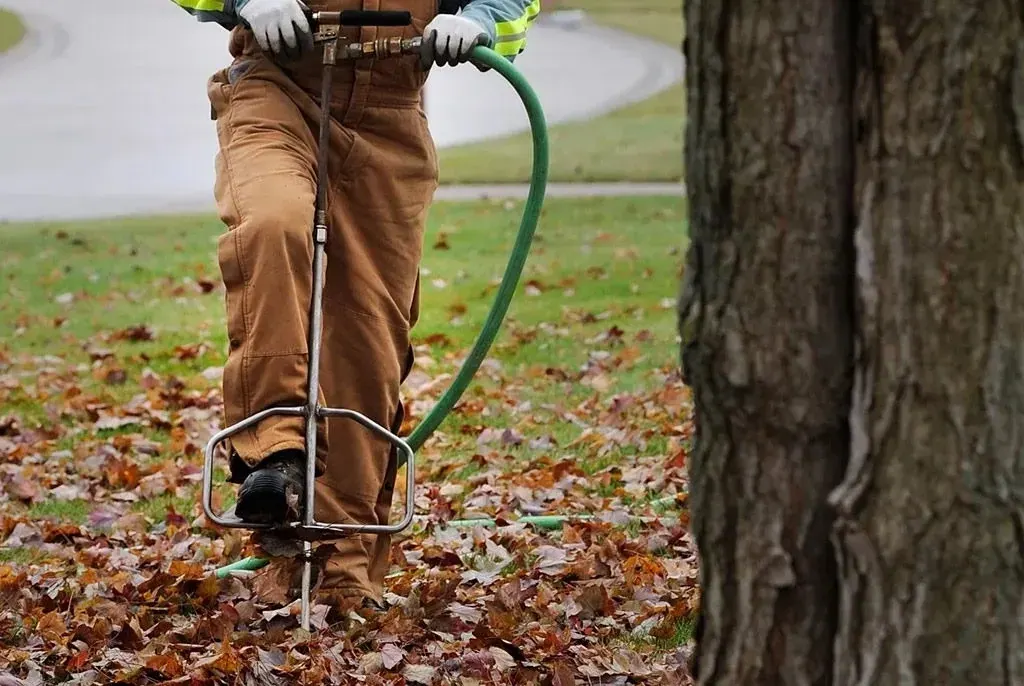
We list deep root injections as a service intended to place nutrients into the root zone of trees and shrubs.
That is a fundamentally different approach from applying something to foliage.
It also means the decision should start with the plant and site rather than with the equipment used to apply the treatment.
- What condition is the tree in?
- How has the surrounding landscape changed?
- Has construction happened nearby?
- Is the plant competing with dense turf or other roots?
- Has the soil around it been compacted?
Those are useful questions before deciding what kind of plant-health service makes sense.
A deep root treatment should not become a routine answer to every yellow leaf simply because we offer it.
Our broader plant-health menu gives the technician several other directions depending on what is actually found.
Pruning may be part of the conversation without being the whole answer
We also provide dormant pruning for trees and shrubs.
Pruning can change plant structure and remove particular growth, but it does not correct every underlying health problem.
A homeowner may be looking at a thin canopy and assume the plant should be cut back. The plant-health technician may see something else happening.
This is where separating appearance from condition is useful.
A shrub can be overgrown and healthy.
Another can be neatly shaped and under stress.
The treatment should follow what the plant needs rather than the visual complaint alone.
Our current blog already covers pruning timing and general tree and shrub care, so a site visit can build on that seasonal understanding without turning every issue into a pruning appointment.
Deer pressure can complicate what looks like a plant-health problem
We also list deer-control applications as part of plant health.
That is important because missing or damaged growth is not always a nutrient issue or disease.
If a plant is being browsed repeatedly, treating the root zone does not address the reason the foliage keeps disappearing.
The same goes for insect damage or disease symptoms.
This is why the property history helps.
Tell the technician what changed and when. If you regularly see deer in the same bed, mention it. If the plant started declining after construction, share that. If only one species is affected while neighboring plants look normal, that is useful information too.
A plant-health program works better when the technician has the story instead of simply seeing the plant on one day.
Mature landscapes deserve a broader look
Many Pittsburgh-area properties have trees and shrubs that have been in place for years.
The surrounding property may have changed during that time.
New patios get built. Lawns are renovated. Irrigation is altered. Beds are expanded. Shade changes as nearby trees grow or are removed.
Our service mix now includes plant health, lawn programs, irrigation, and landscape work with Eichenlaub, which allows those different parts of the property to be considered together. Ongoing bed and property care can also fall under landscape maintenance.
That is useful because a plant does not know which contractor was responsible for the change around it.
The root zone, water, light, pruning, pest pressure, and surrounding soil all end up affecting the same tree or shrub.
We serve Western Pennsylvania from our Cheswick location, including communities such as Fox Chapel. Call 412-822-9153 or contact us for lawn and plant-health service.